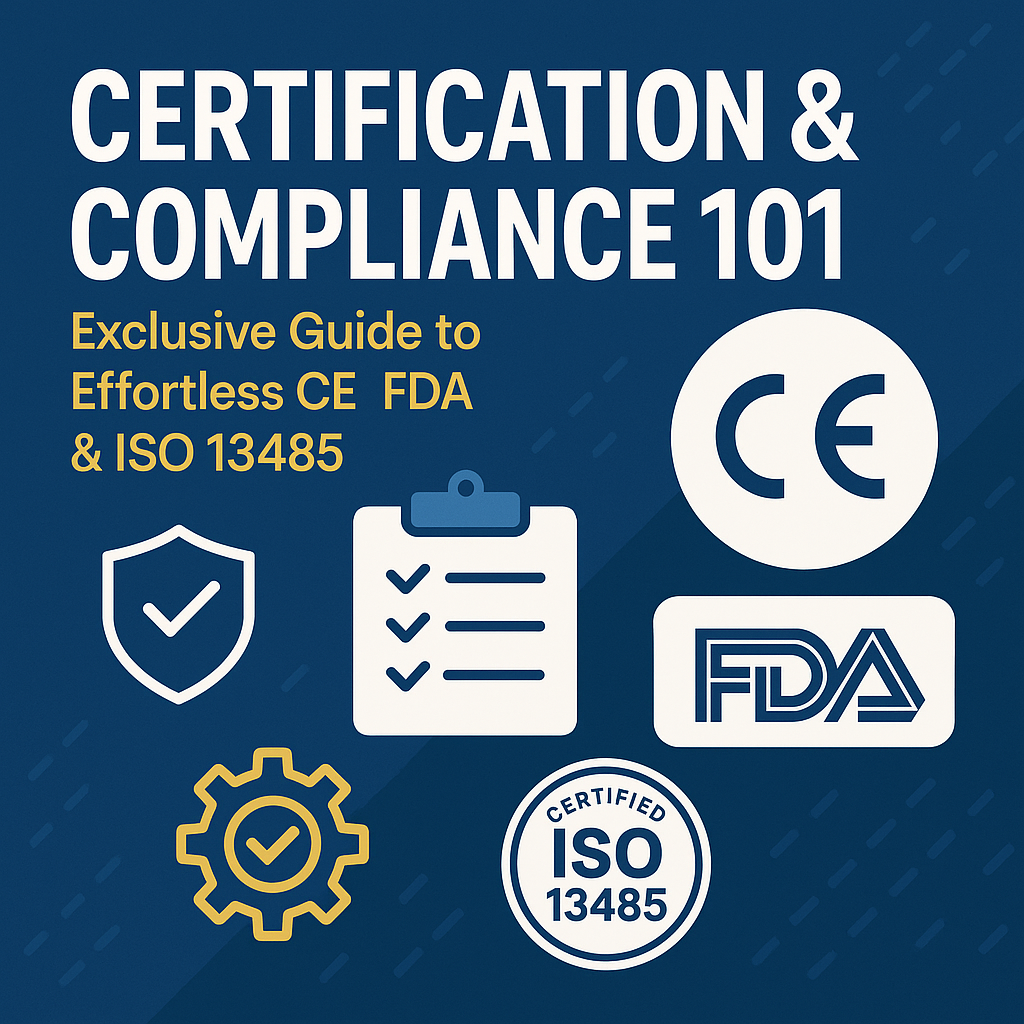
Certification & Compliance 101: CE, FDA, and ISO13485 for Homecare & Rehab Products
When bringing homecare and rehabilitation products to international markets, certification and compliance are crucial to ensure your products meet legal requirements, safeguard users, and establish trust with buyers. Healthcare importers, distributors, and elderly care buyers must grasp the fundamentals of CE marking, FDA clearance, and ISO13485 certification to successfully navigate cross-border regulations and accelerate market entry.
This article breaks down these three key certifications, outlining their purpose, processes, timelines, and practical tips to help you import and distribute homecare and rehab aids with confidence and compliance.
Why Certification and Compliance Matter for Homecare & Rehab Products
Certification and regulatory compliance provide multiple benefits, including:
- Regulatory Approval: Products must meet market-specific requirements such as the EU’s Medical Device Regulation (MDR) or the US FDA’s conditions.
- Product Safety: Compliance ensures devices do not pose risks to vulnerable users such as the elderly or patients with disabilities.
- Market Access: Certified products can be sold in hospitals, nursing homes, and retail outlets across different regions.
- Brand Credibility: Certifications build trust among customers and healthcare professionals.
- Risk Management: Proper compliance reduces liability, product recalls, and reputational damage.
CE Marking: Entering the European Market
What Is CE Marking?
CE marking is a declaration that a medical device complies with the EU’s Medical Device Directive (MDD) or the stricter Medical Device Regulation (MDR). It’s mandatory for any device entering the European Economic Area (EEA), signaling conformity with safety, health, and environmental standards.
Key Steps to Obtain CE Marking
- Device Classification: Classify your product into Class I, IIa, IIb, or III based on risk level.
- Technical Documentation: Prepare a comprehensive Technical File including design details, risk assessments, clinical data, and labeling.
- Notified Body Engagement: For Class IIa and above, appoint a Notified Body to conduct conformity assessments. Class I devices may self-certify.
- Conformity Assessment: This can range from type examination to full quality assurance, depending on the device class.
- Affixing CE Mark and Declaration: Once requirements are met, affix the CE mark and prepare the EU Declaration of Conformity.
Timeline & Cost Considerations
- CE marking typically takes 3 to 6 months for Class I devices and up to 9 to 12 months for higher classes.
- Costs vary significantly, from approximately €3,000 to €25,000, depending on complexity and Notified Body fees.
FDA Clearance: Accessing the US Market
Understanding FDA Pathways
The US Food and Drug Administration (FDA) regulates medical devices through different pathways depending on risk:
- 510(k) Pre-Market Notification: For most Class II devices, demonstrating “substantial equivalence” to an existing legally marketed product. Requires submitting device descriptions, performance and biocompatibility testing results, and labeling information.
- De Novo Pathway: For novel low-to-moderate risk devices without a predicate device.
- Premarket Approval (PMA): For high-risk Class III devices requiring extensive clinical data.
Timeline & Cost Breakdown
- 510(k) Review: Typically 3 to 6 months; fees around $4,624 (with discounts possible for small businesses).
- De Novo: Can take 6 to 12 months; fees close to $93,229.
- PMA: The most rigorous route, taking 12 to 24 months; fees approximately $374,858.
ISO13485: Quality Management for Medical Devices
What is ISO13485?
ISO13485 is a globally recognized standard specifying requirements for a medical device quality management system (QMS). It emphasizes risk management, traceability, and ongoing improvement of processes and products.
Benefits of ISO13485 Certification
- Exhibits supplier reliability and consistent manufacturing quality.
- Supports regulatory submissions to CE and FDA authorities by documenting a controlled QMS.
- Enhances customer confidence, reduces audit findings, and helps manage supplier and operational risks.
Implementation Process
- Conduct a gap analysis comparing existing processes to ISO13485 standards.
- Develop or update QMS documentation such as procedures, work instructions, and records.
- Train employees and perform internal audits.
- Select and undergo audits by an accredited certification body.
- Achieve ISO13485 certification through successful external audits.
Practical Tips for Importers in Homecare & Rehab Product Markets
- Plan Ahead: Incorporate certification timelines into your procurement and launch schedules.
- Budget Accordingly: Allocate funds for consulting, testing, Notified Body fees, and FDA user fees.
- Maintain Communication: Work closely with your supplier’s regulatory specialists for timely documentation and compliance updates.
- Organize Documentation: Keep all technical files, audit records, and correspondence accessible for inspections.
- Post-Market Surveillance: Establish procedures for monitoring customer feedback, complaints, and corrective actions.
Partner with Tenrova Healthcare for Certified, Compliant Products
Navigating the maze of CE marking, FDA clearance, and ISO13485 certification can be daunting. However, selecting a reliable partner simplifies the process.
Tenrova Healthcare provides factory-direct homecare and rehabilitation aids with full CE, FDA, and ISO13485 certifications. Our quality management systems and up-to-date regulatory compliance empower you to import products safely, confidently, and competitively.
Contact Tenrova Healthcare today to learn how we can support your import needs:
- Email: hysun0516@gmail.com
- WhatsApp/Phone: +86-138-1239-0890
- Website: https://tenrova.com
By understanding and applying these certification standards, healthcare importers, distributors, and elderly care buyers can ensure smooth, secure market access for vital homecare and rehabilitation products worldwide.